Starting a bakery business in Dubai 2026: Step-by-step guide to licensing, setup, and growth
Starting a bakery business in Dubai 2026: Step-by-step guide to licensing, setup, and growth
Master the essential requirements—from obtaining your food business license to setting up a commercial kitchen and choosing the right bakery equipment to comply with Dubai’s food safety standards.
Vincy Amirtharaj
58 post
Senior Business Setup Consultant, Dubai
Turning your passion for baking into a successful and financially viable bakery venture will require more than just the best baked goods. You must have a strategic bakery business plan. Whether you plan for a quaint artisan bread shop or a large-scale wholesale pastry production facility, it is crucial that you define your bakery concept at the beginning itself. Your initial step is to identify your niche market and understand your target audience by determining the types of baked goods they desire, such as gluten-free products, wedding cakes or rustic sourdoughs and how much they are willing to spend.
After determining your bakery vision, you will focus on the operational efficiencies and most importantly your commercial baking equipment. Selecting the right machinery, such as spiral mixers for dough development and deck ovens for that perfect crust directly affects your daily production capacity and product consistency. A major challenge when opening a bakery is balancing product quality with the cost to open a bakery. By making smart investments in durable equipment and an efficient kitchen layout, you can lower labor costs and improve your back-of-house workflow from day one.
Lastly, an owner must have a solid bakery marketing strategy in order to achieve sustainable growth. The ability to effectively use both traditional word-of-mouth and modern digital marketing methods is crucial to attracting new customers. Using these methods, you can promote high-margin items like custom cakes , on social media. Seasonal promotional advertising will also help to keep people coming to your bakery by creating a buzz around what is being offered. As your business continues to adapt to evolving consumer preferences, including the growing demand for vegan options and eco-friendly packaging, it will be well-positioned to succeed in a crowded and highly competitive food service industry.
Typical 8-week setup timeline
Week
Authority / Task
Key output
1
DET or Free Zone
Initial approval ✓ | Trade Name Reservation Certificate ✓
Note: Cloud kitchens (delivery-only) can compress Weeks 2-5 by renting pre-approved units; waiting for Fit-out inspections is the main variable.
"Dubai's food security and safety strategy aims to position the emirate as a global hub for food trade and innovation, ensuring the highest standards of safety for consumers."
- Dubai Municipality Strategic Plan
Select the DET / free-zone activity that matches your service model:
Retail bakery
Physical shop selling bread, cakes, and pastries to walk-ins.
Cloud kitchen / Dark kitchen
Delivery-only model via Talabat/Deliveroo (lower overheads).
Home Bakery License
For UAE Nationals/Residents (DED Intelaq) baking from home.
Pastry & Sweet Shop
Focus on confectionery, chocolates, and arabic sweets.
Industrial Bakery
Mass production for supplying supermarkets and hotels (B2B).
Cake Decoration Studio
Custom luxury cakes for weddings and events (high margin).
Bakery Café / Restaurant
Requires 'Restaurant' activity if serving full meals + seating.
Pro tip
Clarify if you just sell bread/cakes or if you serve coffee/meals. Adding "Café" to your activity requires extra approvals but increases average ticket size.
Step 2: Choose a trade name
Pick a unique, appetizing name, then reserve it with DED (mainland) or your chosen free zone. Ensure it doesn't violate cultural norms (e.g., no religious terms) and is available as a. ae domain. Finalizing your identity early provides a solid foundation as you set up your business in Dubai.
Quick Fact
Dubai welcomed 17.15 million international visitors in 2023 alone, and the average resident eats out (or orders in) 2.5 times a week, driving massive demand for baked goods.
*While bank guarantees are removed, expect 5-10% security deposits for retail premises rent.
Setup-cost estimator (AED)
Estimated setup cost: —
Get detailed breakdown on WhatsApp
*Includes AED 740 for initial approval (120) + trade-name reservation (620).
Kitchen equipment, fit-out & ingredient stock vary—chat with us for an exact quote.
Step 4: Select a business structure
Pick the vehicle that fits your ownership model & liability appetite:
LLC (Mainland)
Standard for retail bakeries & cafes; allows multiple shareholders.
Sole establishment
Ideal for freelance cake artists or small home-based setups.
Free Zone FZ-LLC
100% foreign ownership—best for central production units or dark kitchens.
Branch office
Extend an existing international bakery brand into Dubai.
Pro tip
Since 2021, you do not need a local sponsor for a Mainland Bakery LLC; 100% foreign ownership is now standard for this activity.
Planning a bakery business in Dubai? Start with the right setup path
Access a clear, step-by-step setup framework designed specifically for bakery businesses in Dubai.
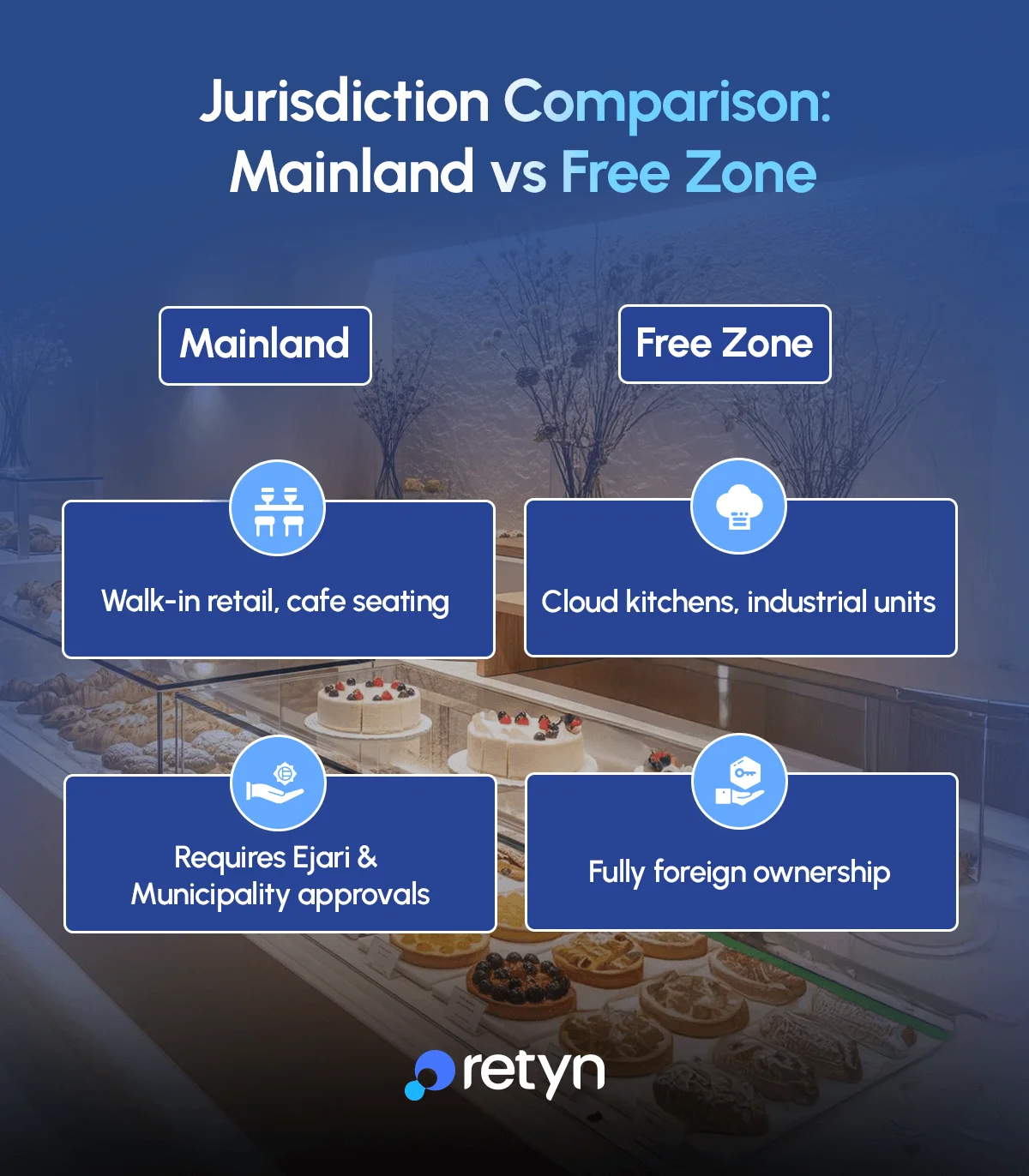
Select the zone that best supports your sales channel (Walk-in vs. Delivery) and client base.
Mainland
Mandatory if you want a physical shopfront, cafe seating, or direct sales to consumers.
Requires DET licence, Ejari, and rigorous Dubai Municipality Food Control approvals. Navigating these requirements is a standard part of mainland company formation in Dubai.
Key requirements:
Dubai Municipality Approval
Approval of kitchen layout and food safety systems.
Ejari tenancy registration
Physical shop lease (minimum 200 sqft usually required).
Civil Defence Certificate
Required for gas connections and fire safety systems.
Free zones
Ideal for "Cloud Kitchens" (delivery only) or industrial manufacturing where you supply B2B (hotels/airlines).
Popular zones include Dubai CommerCity (DCC), DWC, or JAFZA for food processing. Many startups favor free zone company formation in Dubai as a way to test the market with lower overhead costs.
Ideal for:
Food Processing (JAFZA)
Large scale manufacturing for export or supermarket supply.
Cloud Kitchens
Aggregator-focused models (Deliveroo/Talabat) with lower rent.
Online Bakeries
Selling packaged goods via website/Instagram (No walk-ins).
Quick Fact
The UAE Bakery Products Market size is projected to grow at 5.8% CAGR, reaching $3.2 billion by 2030.
Source: Ken Research
Step 6: Register & obtain your bakery licence
Submit forms, secure your trade name, and—most importantly—begin the technical approval process with the Food Safety Department.
Mainland
Food Safety Department (Dubai Municipality)
Approval of kitchen layout (flooring, ventilation, grease traps).
Civil Defence
Fire safety certificate (LPG connections & suppression systems).
DET Trade License
Issued only after initial Municipality & Civil Defence clearances.
Free zone
Online application (DCC, JAFZA)
Submit concept and shareholders' documents digitally.
Lease Agreement
Must be a purpose-built food & beverage unit (not a standard office).
Activity codes
Select "Bakery" or "Food Stuff Trading" codes.
Foodwatch Registration
Even Free Zone food businesses must register on Dubai's Foodwatch platform.
Licence-application document checklist
Mainland LLC / Sole Establishment
Passport & UAE entry stamp (all shareholders)
Emirates ID or UID number
Kitchen Layout Drawing (DWG/AutoCAD)
Ejari certificate (Shop/Kitchen lease)
NOC from Landlord for food activity
Initial approval & trade-name certificates
Civil Defence compliance certificate
Free zone (e.g., DWC/DCC)
Passport copy (all shareholders)
Visa / entry stamp or last visit date
Shareholder CV + photo
Lease for Warehouse/Kitchen unit
Activity-code selection form
HACCP / Food Safety Plan (if industrial)
Proof of address (utility bill or bank statement)
Tip: Ensure your kitchen layout clearly marks "Clean" vs "Dirty" zones to pass the first inspection.
sequenceDiagram
participant Founder
participant DED as DED / Free Zone
participant DM as Dubai Municipality
participant CD as Civil Defence
participant Bank
participant GDRFA
Founder->>Founder: 1 · Define Menu & Concept
Founder->>DED: 2 · Reserve Trade Name & Initial Approval
Founder->>Founder: 3 · Sign Lease (Ejari)
Founder->>DM: 4 · Submit Kitchen Layout for Assessment
DM-->>Founder: Layout Approved
Founder->>CD: 5 · Install Fire Safety Systems
CD-->>Founder: Safety Certificate Issued
Founder->>DED: 6 · Pay Fees & Issue License
DED-->>Founder: Trade License Issued
Founder->>GDRFA: 7 · Staff Visas & Health Cards
GDRFA-->>Founder: Visas Stamped
Founder->>DM: 8 · Final Kitchen Inspection
DM-->>Founder: Permit to Trade (Go Live!)
Note over Founder: 9 · Renewals (License · OHC · Pest Control)
Beyond standard residency visas, every person handling food (bakers, baristas, servers) must pass a medical test and obtain an Occupational Health Card (OHC) from DHA. Integrated UAE visa processing services often include support for these specialized permits.
Pro tip
Staff must also undergo Basic Food Hygiene training (Level 1) from an approved training centre to comply with the Person In Charge (PIC) program.
Get expert input on your bakery business plan
Use a free consultation to evaluate your bakery setup approach and identify potential gaps before moving forward.
Provide your trade licence, tenancy contract (Ejari), supplier agreements, and a 12-month cash-flow forecast. For retail bakeries, banks often request details on your POS system provider.
Trade licence
Issued by DET or Free Zone Authority.
Cash-flow forecast
Projections for ingredient costs, rent, and daily covers.
Supplier Agreements
Contracts with flour, dairy, and packaging vendors.
Website & corporate email
Live site (even a landing page) & domain email.
Premises Lease
Ejari for your shop or kitchen unit.
Consider professional corporate-banking assistance to navigate high-risk assessments for cash-heavy retail businesses.
Step 9: Secure external technical approvals
Before you can bake your first loaf, these specific operational permits are mandatory:
Grease Trap Permit
Dubai Municipality requires a contract with an approved waste hauler.
Pest Control Contract
Mandatory annual contract with a municipality-approved firm.
Food Transportation Permit
If delivering cakes/bread, your vans need specific Food Control approval.
If you plan to import specialized organic flour or ingredients directly, you must also register them via the ZAD (Federal) or FIRS (Dubai) import systems.
Step 10: Arrange insurance & guarantees
Protect your business with Product Liability (covers food poisoning claims), Public Liability (customer slips/falls), and Property All Risk (covers expensive ovens/mixers).
If you plan to scale beyond simple retail, or if you handle high-risk items, you need specific additional clearances: Addressing these permits early in the process of starting a business in Dubai prevents costly delays during your final inspection.
HACCP Certification
Mandatory for catering companies and industrial bakeries supplying hotels/airlines.
Catering Services Permit
Required if you serve food outside your premises (e.g., wedding cakes, corporate events).
Halal Certification
Essential if you plan to export baked goods to other GCC countries (Saudi Arabia/Oman).
Food Transportation Permit
Municipality approval for chiller vans used to deliver perishable cakes/pastries.
Pro tip
Maintain a digital "Supplier Traceability" folder. If a batch of flour is recalled, Dubai Municipality expects you to identify exactly which cakes used that batch within 4 hours.
Expert insight: The "High-Yield" bakery model for 2026
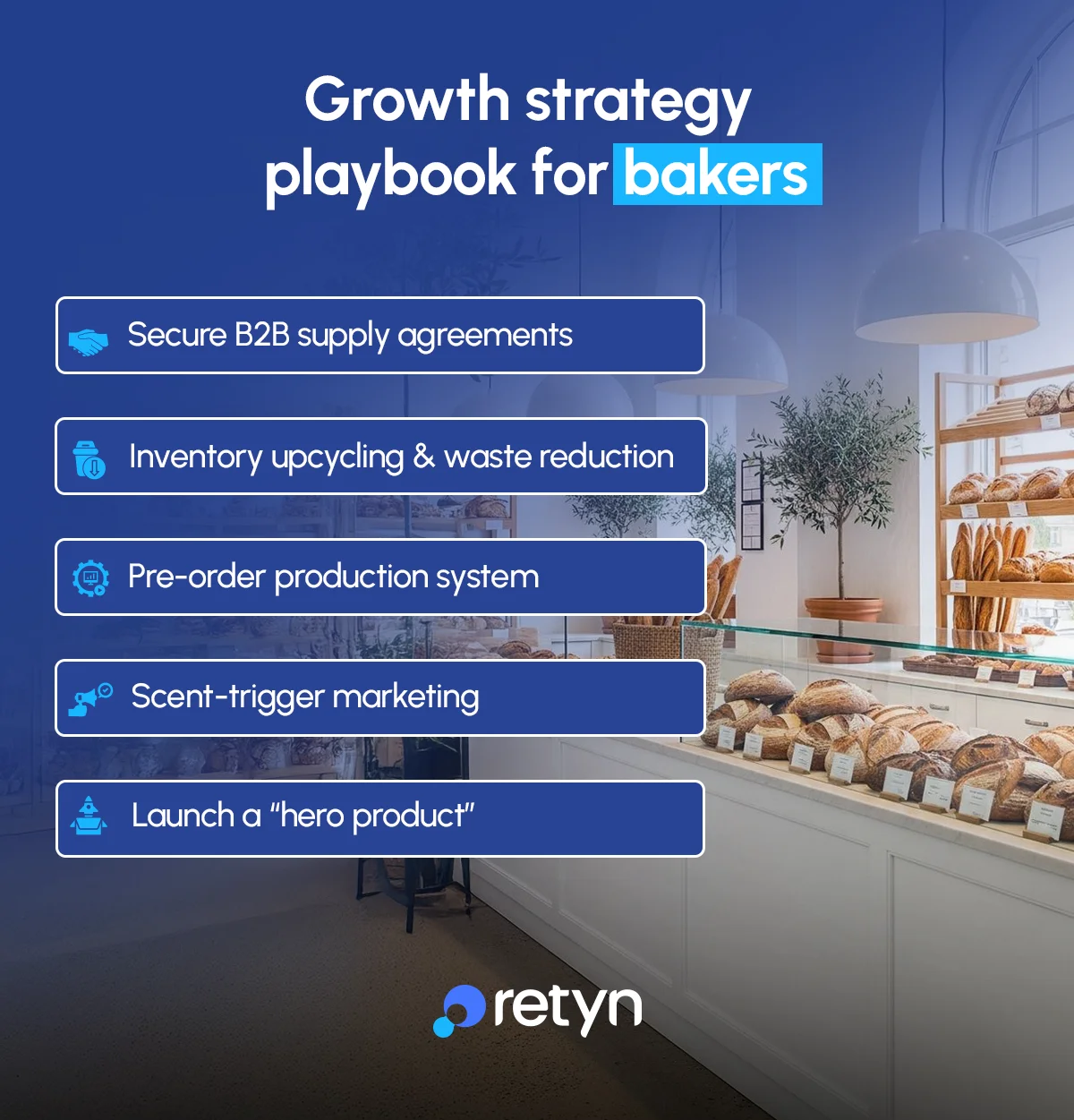
There are 5 strategic pivots separating profitable bakers from struggling hobby-businesses in the current market. These include Data-Driven Menu Engineering, a Hybrid Wholesale Backbone, Zero-Waste Production Loops, Pre-order Production Modeling and Strategic Sensory Marketing. A bakery owner who treats flour and butter as currency can optimize every gram by utilizing technology such as pre-orders to maintain a Cost of Goods Sold (COGS) at or below the industry benchmarks.
The five operational levers that enable a new owner to build a scalable, resilient and cash-flow-generating business from day one is outlined below.
Menu Engineering: The "Star vs. Dog" Audit
The "Star vs. Dog" audit does not simply measure how well an item sells. It measures profit contribution per item. Protect your "Stars," which are high-selling, high-margin products.
Re-engineer "Dogs" by either removing them from the menu or redesigning them to reduce inventory complexity and employee training costs.
The Wholesale "Safety Net"
B2B relationships can act as a wholesale "Safety Net" for your business during periods of low retail foot traffic. Secure supply agreements with 3–5 local coffee shops (B2B) for pastries. This base volume helps cover fixed overheads such as rent and utilities. As a result, walk-in retail sales contribute largely as pure profit.
Inventory Upcycling & Waste Reduction
Give each item in your inventory a second life. For example, day old croissant can be converted into an almond croissant (and sold at a premium) and leftover sour dough is transformed into artisanal breadcrumbs or croutons.
The result will be lower food costs and the ability to appeal to customers who are conscious of environmental issues.
Pre-Order Production Modeling
Utilize a 48-hour pre-order system for high ticket items such as whole cakes or bread subscriptions.
This shifts your operation from "predictive baking" (baking based upon what you think demand will be and risking waste) to "production on demand" (zero waste, all revenue is guaranteed).
Strategic Sensory Marketing
If your location allows, invest in ventilation routing that direct oven fumes on the street or pedestrian area so you can take advantage of the "scent of fresh bread." This has been shown to be an identifiable neurologic trigger that will increase walk-in conversions without any additional advertising.
Pro tip
Launch with a "Signature Item" that is visually distinct (e.g., a Cruffin or a specific Sourdough score). Use this "hero product" to drive social media shares, while your standard high-margin items (coffee, cookies) drive the actual profit.
Decision snapshot – what to choose, at a glance
Structure / License
Walk-in Traffic
Delivery Apps
Setup Speed
Rent Cost
Premises Rule
Mainland Retail Shop
✓ (Yes)
✓
4-6 weeks
High
Commercial shop required
Cloud Kitchen (Free Zone)
X (No)
✓
2 weeks
Low
Kitchen unit only
Home Bakery (Intelaq)
X (No)
Limited*
1 week
Zero
Residential kitchen
Industrial Bakery (JAFZA)
X (No)
B2B
8-12 weeks
Medium
Warehouse factory
* "Home Bakeries" can sell via Instagram/Website but often face restrictions listing on major aggregators without a commercial kitchen.
Risk & penalty matrix – Food safety fines
Offence
Fine (AED)
Consequence
Dealing in food or products that contain pork or alcohol or any of their by-products without permission
500,000
Prison term of not less than a month
Misleading consumers by publishing a false description of food
10,000 - 100,000
Temporary closure
Selling food with expired ingredients
1,000 - 5,000
Confiscation & hygiene downgrade
Figures based on Dubai Municipality Food Control regulations. Repeated violations lead to permanent license revocation.
Renting a shop with insufficient electrical load (Bakery ovens need high kW).
Signing a lease before getting Kitchen Layout Pre-approval (costly mistake if layout is rejected).
Ignoring Allergen Labeling rules (Menu items must display allergens clearly).
Failing to install a Grease Trap—drainage blockage fines are severe.
Not having a designated "Person in Charge" (PIC) certified staff member on every shift.
Regulation & News updates · 2025
Single-Use Plastic Ban – Jan 2025:
Complete ban on single-use plastic bags, cups, and styrofoam containers. Bakeries must switch to paper or biodegradable alternatives immediately.
Mandatory Calorie Labeling:
All bakeries and cafes with 5+ branches must display calorie counts on physical and digital menus (including Talabat listings).
ZAD Federal Portal:
All imported food ingredients (specialty flours, chocolates) must be registered in the ZAD portal for tracking and approval.
Glossary of acronyms
HACCP - Hazard Analysis Critical Control Point
OHC - Occupational Health Card (DHA)
PIC - Person In Charge (Food Safety)
POS - Point of Sale System
Q-Commerce - Quick Commerce (Delivery <20 mins)
CT - Corporate Tax (9%)
FIRS - Food Import & Re-export System
FAQs on starting a bakery business
For a standard 1,000 sq. ft. retail bakery, the all-in cost typically ranges from AED 120,000 to AED 600,000. However, there are hidden costs that are often overlooked, including grease trap installation (AED 2,000–5,000), power upgrades for deck ovens and the three-month rent deposit required by most commercial landlords.
Yes, you can bake from home in Dubai but only if you get the proper permits and licences for it. Dubai Municipality states that all food products being sold to the general public will have to be produced in licenced and inspected facilities that comply with food safety standards. Selling baked goods from home regardless of the type of product is prohibited by law without a licence.
Buying second-hand equipment has both pros and cons regarding your overall safety in the kitchen.
Smart Buy: A good investment would be purchasing stainless steel tables, racks, and gas ovens that have simple mechanical components. These items are a smart buy because they are low risk to purchase and will provide long-term service and cost savings.
High Risk: On the other hand, there are high-risk purchases such as spiral mixers and refrigeration units. Purchasing a spiral mixer can be an extremely high-risk investment if the gear system on the mixer has been stripped. Repairing it may be more expensive than purchasing a new one. For this reason, always run all used equipment under load before you make your final decision to purchase.
Use the Retarded Proving method. This involves making your dough during the day, placing it into a retarder (your refrigerator) and then baking it at 6 AM the next morning. This improves the overall depth of flavors and also eliminates the need for the graveyard shift.
The "old" "ingredients x 3" pricing formula is obsolete. It's time for a new way of thinking about pricing for profitability. The Prime Cost Method uses the following formula, COGS + Direct Labor = Ideally < 55-60% of your selling price.
For example, if you have a croissant with an ingredient cost of AED 2.20 and direct labor cost of AED 1.50, then your total prime cost will be AED 3.70. Your minimum required selling price, to maintain a 60% prime cost, would be approximately AED 6.20. Many bakeries, located in high rental areas such as Dubai, increase their prices on similar items to provide adequate income to pay for rent, utilities, waste, VAT and profits.
In general terms, most bakeries experience waste at approximately 8-10% of production. In contrast to other bakeries, however, those that are making a profit tend to be below 4%. To reach this goal, you must monitor your waste daily and implement an upcycling plan, such as turning stale loaves into bread pudding, producing croutons or offering discounted “surprise bags.”
Instagram helps to create buzz for your bakery. However, it does not generate revenue as a website will. You can also use a website to generate income in ways that Instagram can’t. It enables you to capture Search Engine Optimization (SEO) for terms like “birthday cakes near me,” directing potential customers to your website where they can place an order. Additionally, a website lets you set up automated pre-orders and take payments while you are asleep. Relying only on direct messages from Instagram to receive orders is a guaranteed way to experience burnout.
Disclaimer: This content is for information only and not legal advice. Food safety regulations change frequentl—always consult a qualified business setup advisor.
Ready to launch your dream bakery?
Book a free consultation to discuss location, licensing, and kitchen approvals.